Most of us eat the way we do everything else we consider routine — automatically, quickly, and with our attention somewhere else entirely. We scroll through our phones between bites. We eat at our desks. We finish a meal and barely remember tasting it. Food has become fuel, consumption has become habit, and the table — once the centre of family and community life — has become just another place to be somewhere else.
Buddhist mindful eating is a direct and practical response to this. It is one of the oldest contemplative practices in the world, and one of the most immediately accessible. You do not need a meditation cushion, a teacher, or years of practice to begin. You need only a meal and the willingness to pay attention.
This is a beginner’s guide to mindful eating from a Buddhist perspective — what it is, why it matters, and five simple practices you can start today.

What Buddhist Mindful Eating Actually Means
The word mindfulness comes from the Pali word sati — awareness, attention, presence. In Buddhist teaching, mindfulness is not a technique for stress reduction, though it often reduces stress. It is a fundamental quality of clear seeing: the capacity to be present to what is actually happening, without the distortion of habit, craving, or inattention.
Applied to eating, mindfulness means bringing that same quality of clear seeing to the meal in front of you. It means noticing — really noticing — the colour, texture, aroma and taste of what you are eating. It means being present to the sensations of hunger and satisfaction. It means recognising, even briefly, the vast web of causes and conditions that brought this food to your table.
This is not complicated. But it is surprisingly rare. And when we do it — even for a single meal, even imperfectly — something shifts.
Why the Buddhist Tradition Takes Eating So Seriously
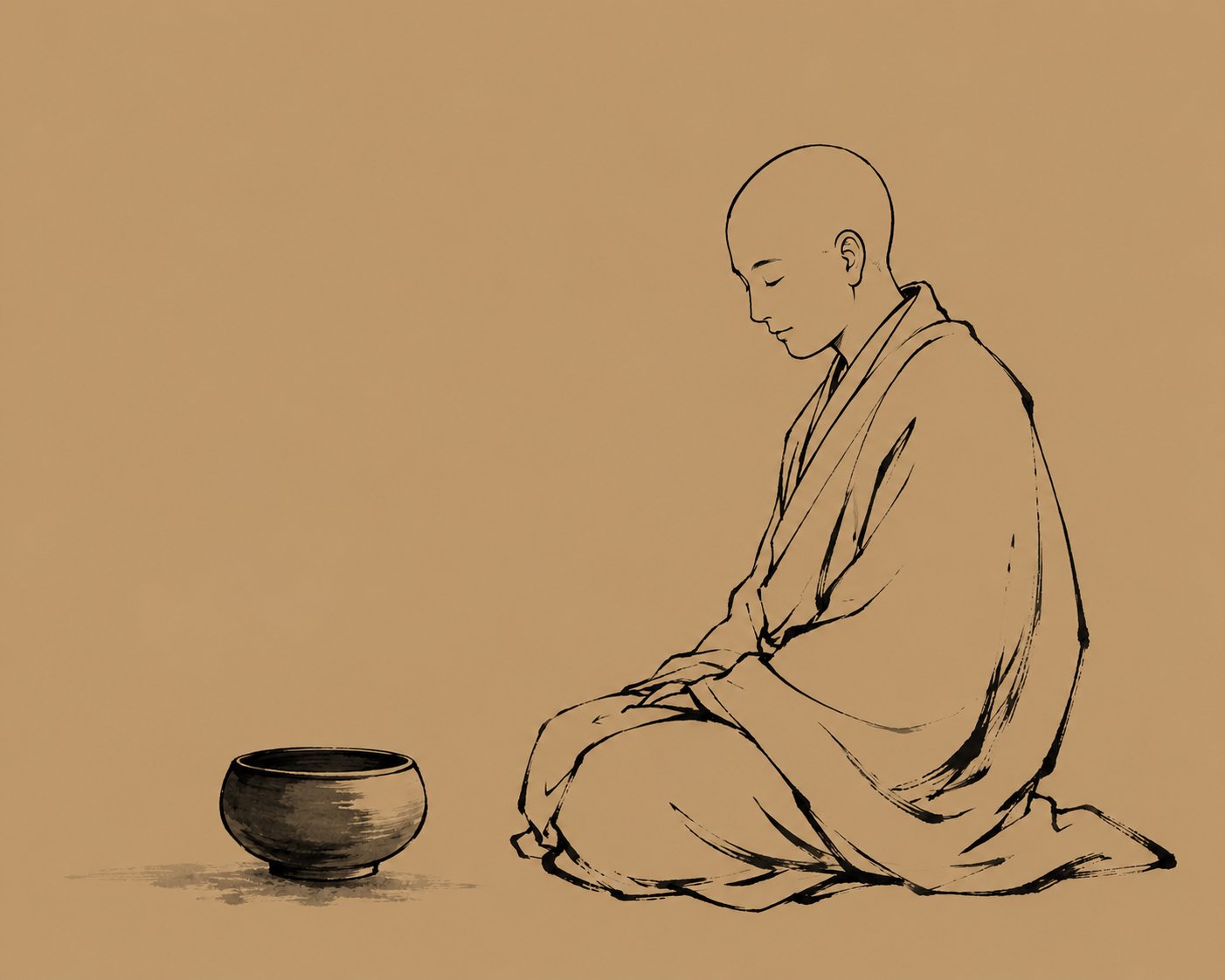
In traditional Buddhist monasteries, the midday meal is a formal practice. The community gathers in silence. Before eating, specific contemplations are recited. Each bite is taken slowly, with full attention. The meal ends when the bowl is empty, not when distraction calls.
This is not asceticism — the Buddha explicitly rejected extreme deprivation as a spiritual path. It is recognition that eating is one of the most intimate acts of our lives. Three times a day, we take the outside world inside ourselves. We transform other life into our own life. Done with awareness, that act becomes profound. Done without awareness, it becomes one more opportunity for unconsciousness.
The Vietnamese Zen teacher Thich Nhat Hanh, who has written more beautifully about mindful eating than almost anyone, puts it simply: “While washing the dishes one should only be washing the dishes.” The same applies to eating. While eating, one should only be eating.
5 Buddhist Mindful Eating Practices for Beginners
1. The Pause Before Eating
Before you take your first bite, stop for ten seconds. Look at your food. Notice its colours, its arrangement, its aroma. Take one slow breath. This single practice — the briefest possible interruption of automatic eating — begins to create the space in which mindful eating becomes possible.
In Buddhist monasteries this pause takes the form of a brief recitation or gatha. You do not need the words. The pause itself is the practice.
2. The Five Contemplations
Traditional Buddhist communities recite five contemplations before meals. You can adapt these as a silent reflection rather than a formal recitation:
This food is a gift of the whole universe — the earth, the sky, the rain, and the sun.
I am grateful to all who brought it to my table.
I eat with moderation, only as much as I need.
I eat to nourish my body and support my practice.
I receive this food so that I may live in a way that benefits all beings.
Even a brief, informal version of this reflection — a moment of genuine gratitude before eating — transforms the quality of a meal more than almost any other single practice.
3. The First Bite Practice
Choose one bite — just one — at each meal to eat with complete attention. Put down your fork or spoon. Chew slowly. Notice every dimension of the experience: the texture as it changes, the layers of flavour that emerge, the sensation of nourishment beginning. Then continue your meal as normal.
This is the easiest entry point into mindful eating for beginners. One conscious bite per meal is enough to begin rewiring the habit of automatic consumption. Over time, that one bite naturally expands.
4. Eating Without Screens
The most significant single change most people can make to their relationship with food requires no Buddhist philosophy at all — simply eating without a screen in front of them. No phone, no television, no laptop. Just the meal.
Research consistently shows that screen use during meals increases calorie consumption, reduces satisfaction, and impairs our ability to recognise hunger and fullness signals. Buddhist teaching would explain this simply: when attention is elsewhere, we are not eating — we are merely consuming. The food passes through us without ever really being received.
Try one screen-free meal per day. Notice what changes.
5. The Gratitude Practice
At some point during your meal — or after it — spend thirty seconds tracing the journey of one ingredient back through its origins. The carrot on your plate: the seed, the soil, the rain, the farmer’s hands, the lorry, the shop, the person who cooked it. Each link in that chain is a real relationship, a real act of labour, a real contribution to the moment of nourishment you are experiencing.
This practice is the direct application of the Buddhist teaching on interdependence — pratityasamutpada — to the act of eating. When we truly see the web of relationships that produced our food, gratitude is not a forced sentiment. It arises naturally, as the only appropriate response to what we are actually receiving.
What Buddhist Mindful Eating Does to Food Choices
Something interesting happens when we eat with genuine attention over time. Our relationship with food changes — not through willpower or moral pressure, but through simple awareness.
When we truly taste what we are eating, processed food often becomes less appealing. The artificial flavours that seem satisfying when eaten distractedly reveal themselves as flat and unsatisfying under full attention. Fresh, simply prepared food — a bowl of properly cooked rice, a ripe tomato with olive oil, a piece of well-made bread — reveals extraordinary complexity and pleasure when eaten slowly and consciously.
Buddhist mindful eating also tends, gradually, to shift us toward foods whose production aligns with our values. It is difficult to eat with full awareness of where food comes from and remain entirely indifferent to the conditions in which it was produced. Attention is itself a form of care. And care, extended to our meals, naturally extends to the beings and systems that made those meals possible.
Buddhist mindful eating is not a path that requires sudden transformation or rigid rules. It is a path of gradual awakening — one meal at a time, one conscious bite at a time, one moment of genuine gratitude at a time.
Starting Today
You do not need to adopt all five practices at once. Choose one. The pause before eating is the easiest starting point — ten seconds, once a day, before any meal of your choosing. Do that for a week. Notice what happens.
The Buddhist approach to practice has always emphasised consistency over intensity. A small practice maintained daily is worth infinitely more than an ambitious practice abandoned after three days. Begin where you are. Use what you have. Do what you can.
The table is waiting. The food is already there. The only thing needed is your attention.
Buddhist Mindful Eating is explored in depth in Chapter Four of The Compassionate Table — available now as a PDF or ePub download for €3 at thecompassionatetable.com. Chapter Four: Mindful Eating — read a taster here.

The Buddhist Mindful Eating Photo in this post is by Thai Nguyen Anh on Unsplash
Explore all nine chapters of The Compassionate Table.
Instant download · Secure checkout via Stripe